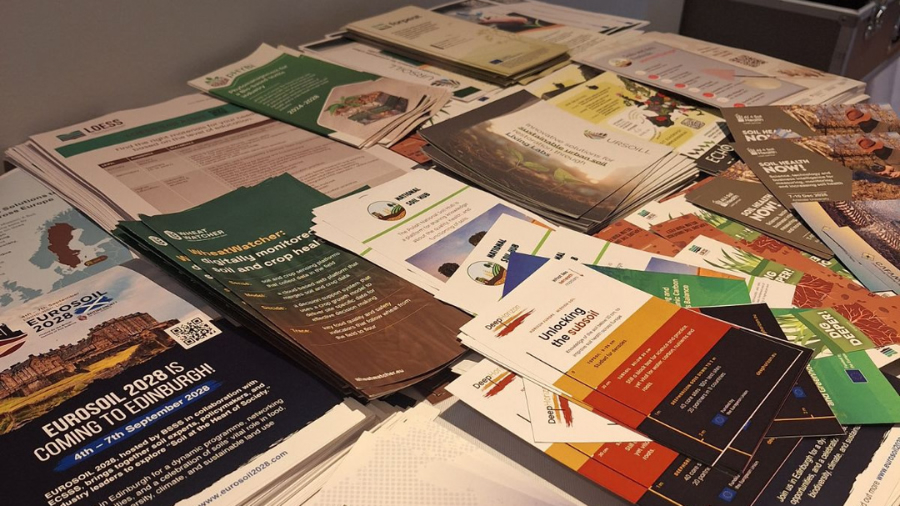
WHEATWATCHER at European Mission Soil Week 2026: From Soil Data to Field Decisions
The European Mission Soil Week 2026 brought together researchers, policymakers, farmers and soil health experts in Dublin, Ireland, on 17–18 November, under the theme “Turning knowledge into impact.”
Hosted by Teagasc and the Irish Presidency of the Council of the EU, the event highlighted an important challenge: Europe is generating increasing amounts of soil data, but how can this scientific knowledge be transformed into practical solutions for farmers, advisors and policymakers?
For WHEATWATCHER, this question lies at the heart of the project’s mission. By connecting advanced soil and crop monitoring technologies with modelling and digital decision-support tools, WHEATWATCHER aims to help agricultural stakeholders make more informed decisions.
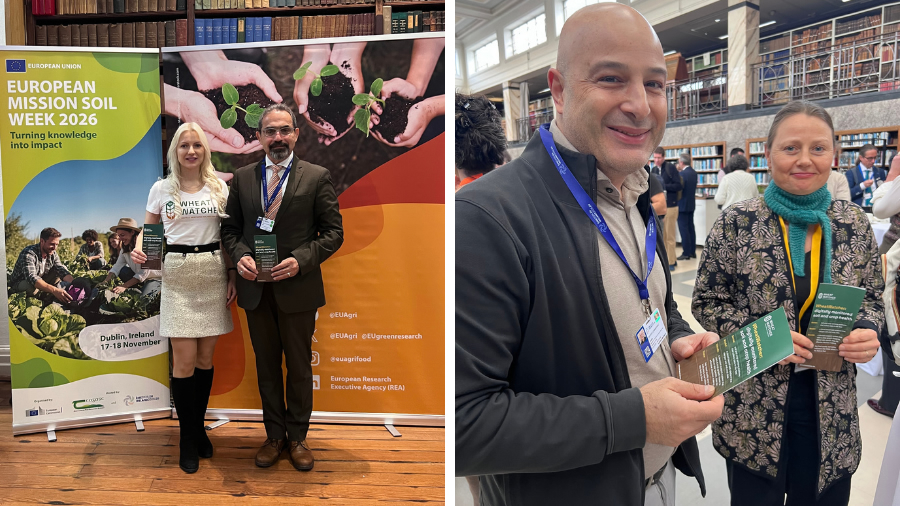
WHEATWATCHER was represented at the event by Prof. Abdul Mounem Mouazen from Ghent University, the project’s coordinator, representatives of ena Development Consultants, and NGO Soil Innovation Cluster.
Their participation reflected the project’s commitment to scientific innovation, knowledge exchange, stakeholder engagement and the dissemination of research outcomes across the European soil community.
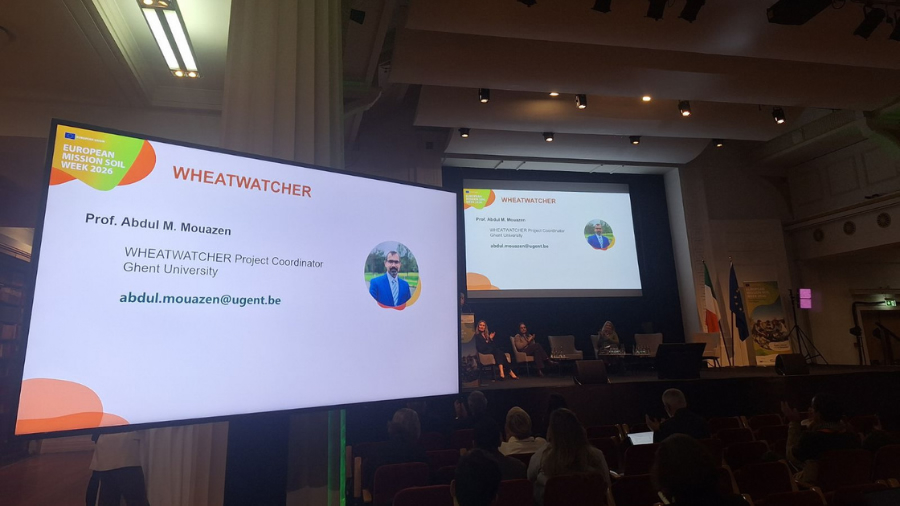
During the event, Prof. Mouazen presented two innovative technologies in the session dedicated to monitoring and assessing soil health.
From soil research to practical implementation
One of the central messages of European Mission Soil Week 2026 was the importance of moving beyond scientific research towards the practical implementation of innovative solutions.
Henri Delanghe, representing the European Commission’s Directorate-General for Agriculture and Rural Development (DG AGRI), emphasised the importance of deploying research outcomes and strengthening the connections between Horizon Europe, agricultural advisory services and the Common Agricultural Policy (CAP).
The EU Mission “A Soil Deal for Europe” has already mobilised substantial research investment and established a growing network of Living Labs, bringing together scientists, farmers and other stakeholders to develop and test solutions under real-world conditions.
This approach closely reflects WHEATWATCHER’s activities at its European pilot sites in Poland, Germany, Greece and Belgium, where advanced sensing technologies and monitoring methods are being developed, adapted and tested in agricultural environments.
Understanding Europe’s soil health challenges
The event also highlighted the continuing pressures affecting European soils.
Cristina Guarda, Member of the European Parliament, drew attention to the importance of addressing soil contamination and ensuring that soil health remains a European policy priority.
Meanwhile, Arwyn Jones from the European Commission’s Joint Research Centre (JRC) highlighted evidence of widespread soil degradation across the European Union.
Recent JRC research indicates that approximately 62% of EU soils are affected by at least one degradation process. Although improvements have been observed in indicators such as water erosion and phosphorus deficiency, other challenges, including soil organic carbon loss, phosphorus excess and soil sealing, continue to raise concerns.
With the EU Soil Monitoring Law now in force, systematic soil assessment is becoming increasingly important for understanding these pressures and supporting evidence-based action.
Within WHEATWATCHER, researchers are investigating soil contamination, nutrient conditions and other chemical and biological stressors, while exploring their relationships with crop development and grain quality.
By combining field measurements, laboratory analyses, sensing technologies and digital modelling, the project aims to provide a more complete picture of soil and crop conditions.
WHEATWATCHER innovations presented by Prof. Abdul Mouazen
A key moment for WHEATWATCHER came during the pitching session on Monitoring and Assessing Soil Health, where Prof. Abdul Mounem Mouazen introduced two technologies being developed within the project.
The first innovation was a robotic system equipped with a multi-sensor penetrometer, designed to investigate soil characteristics at different depths and provide detailed information about the soil profile.
The second was an online soil nitrate sensor, being developed to support more precise monitoring of nitrate conditions and contribute to improved nitrogen management in agriculture.
Both technologies reflect WHEATWATCHER’s approach to integrating innovative sensing methods with practical agricultural monitoring.
Rather than relying exclusively on conventional soil sampling and laboratory analysis, these developments aim to make relevant soil information more accessible and timely.
As the technologies continue to be developed and evaluated, their integration with other WHEATWATCHER monitoring systems could contribute to more detailed soil assessments and better-informed agricultural decisions.
Making soil knowledge useful for farmers
Beyond technological innovation, European Mission Soil Week placed particular emphasis on knowledge transfer and the practical adoption of research outcomes.
Karen Daly from Teagasc highlighted the importance of ensuring that scientific findings can be translated into agricultural advice, changes in management practices and policy support.
Similarly, Tomislav Hengl from the OpenGeoHub Foundation emphasised the need for soil data and digital solutions to remain relevant, up to date and accessible to their intended users.
These perspectives are particularly relevant to WHEATWATCHER.
The project is developing an integrated monitoring approach that connects data from stationary and mobile sensors, field and laboratory measurements, Earth observation and modelling with a digital decision-support system.
The objective is not simply to collect more information, but to make that information useful for farmers, millers and policymakers.
By considering the practical needs of agricultural stakeholders, WHEATWATCHER aims to support the transition from complex scientific datasets towards more accessible and actionable knowledge.
Turning knowledge into impact
European Mission Soil Week 2026 reinforced the importance of collaboration between research, technology, agricultural practice and policymaking.
For WHEATWATCHER, participation provided an opportunity to share emerging innovations, exchange knowledge with other European initiatives and contribute to discussions about the future of soil health monitoring.
The presence of Ghent University, ena Development Consultants and NGO Soil Innovation Cluster also highlighted the collaborative nature of WHEATWATCHER, bringing together expertise in scientific research, communication, dissemination and stakeholder engagement.
The event’s central message closely reflects the project’s ongoing work: scientific data becomes truly valuable when it can support decisions in the field.
Through its European pilot sites, innovative sensing technologies and integrated digital tools, WHEATWATCHER is working towards transforming soil and crop measurements into practical knowledge for more sustainable wheat production.
As European soil research continues to advance, connecting scientific innovation with real agricultural needs will remain essential for achieving healthier soils and more resilient food systems.