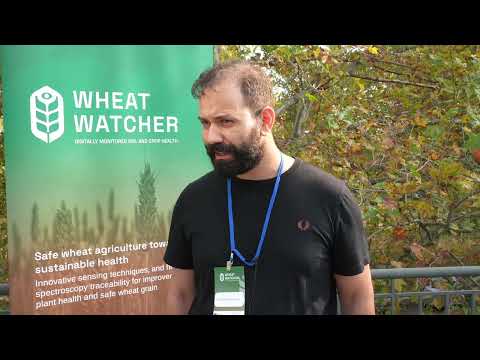
Interview with Scientific Coordinator Dr. Antonios Morellos
As the WHEATWATCHER project moves beyond its first year of development, Mrs. Zafeiro Vaxevanidou, Communication Manager at ena Development Consultants, spoke with Dr. Antonios Morellos, Scientific Coordinator of the WHEATWATCHER project, from Ghent Universtity, about the scientific progress achieved so far and the next steps ahead. During the interview, Dr. Morellos reflected on the key scientific breakthroughs, the development of the project’s sensing platforms, and the priorities for the second year as WHEATWATCHER prepares to deploy its technologies across pilot sites and move into large-scale experimentation.
Could you highlight one or two scientific or technical developments that stand out from the first year?
According to Dr. Morellos, one of the most important scientific developments comes from the work carried out by the team at Tel Aviv University, which conducted glasshouse experiments focusing on the detection of microplastics in soil.
The team successfully identified clear spectral signatures linked to microplastics, representing a significant advancement in the field of proximal sensing technologies used for soil monitoring.
Dr. Antonios Morellos: They have already done a very good job in the glasshouse experiments and have found very clear signatures coming from microplastics. I think this is a kind of breakthrough that sets new ground for proximal sensing, and it could potentially be generalized to detect other contaminants as well.
Alongside these scientific achievements, the project has also made substantial progress on the technical development of its sensing platforms.
Dr. Antonios Morellos: We have already developed or are currently finalising many of the sensing platforms. We are already more than 70% through the development of the sensors, which is a very good achievement for the first year of the project.
These developments create the technical foundation that will allow the project to move into its next phase of research and experimentation.
How are the different sensing platforms progressing, and what results have you seen so far from the pilots?
WHEATWATCHER integrates multiple sensing technologies, combining stationary, mobile, robotic, and remote sensing approaches to monitor soil and crop conditions.
Dr. Morellos explains that the project currently focuses on four main sensing platforms, each contributing different types of data.
The stationary proximal sensing platform, designed as a monitoring station, has already been deployed in experimental setups in Switzerland and Greece.
In addition, the project is developing mobile sensing systems, including platforms for both soil sensing and plant sensing. The soil sensing platform is already very close to completion.
Dr. Antonios Morellos: For the soil sensing platform, we are around 90% finished. It is almost ready.
Another innovative component is the robotic sensing platform, being developed by Exobotic. As a new prototype, the system requires significant engineering work to ensure robustness and reliability under real field conditions.
At the same time, the remote sensing activities are progressing rapidly, with the team at Tel Aviv University leading efforts to integrate satellite data into the monitoring system.
Overall, Dr. Morellos highlights that the progress across the different sensing platforms has been highly encouraging.
Dr. Antonios Morellos: The progress is very good. I am very satisfied with how the development is advancing.
What are the main priorities for the second year of the project?
While the first year focused largely on the development of sensors, models, and technical infrastructure, the second year will mark the start of the project’s core research phase.
Dr. Antonios Morellos: The second year will be the heart of WHEATWATCHER because this is when the actual research begins.
During this stage, the project will deploy the sensing platforms across the pilot fields and begin collecting large amounts of data under real agricultural conditions. These datasets will support the development and validation of models that combine information from multiple sensing technologies.
Dr. Antonios Morellos: Now we will start applying all these sensing platforms in reality, in the pilot fields, and collect as much data as possible.
Another important development during the second year will be the progress of the digital platform being developed by project partners including University of Rostock and FHNW. This platform will ultimately provide farmers and stakeholders with access to the project’s monitoring results and decision-support tools.
Dr. Antonios Morellos: This platform will be the heart of WHEATWATCHER for the farmer. It is what stakeholders will see in the end.”
Dr. Morellos concludes with optimism about the next phase of the project.
Dr. Antonios Morellos: We have a lot to expect from the second year a lot.
Moving Forward
As WHEATWATCHER enters its second year, the project transitions from technological development to real-world validation and large-scale data collection. By integrating multiple sensing platforms and advanced modelling tools, WHEATWATCHER aims to deliver a comprehensive soil health monitoring and decision-support system that can help farmers, researchers, and policymakers better understand soil conditions and support sustainable agriculture across Europe.
Watch the interview in YouTube: