


Building a soil spectral library: Task 3.2
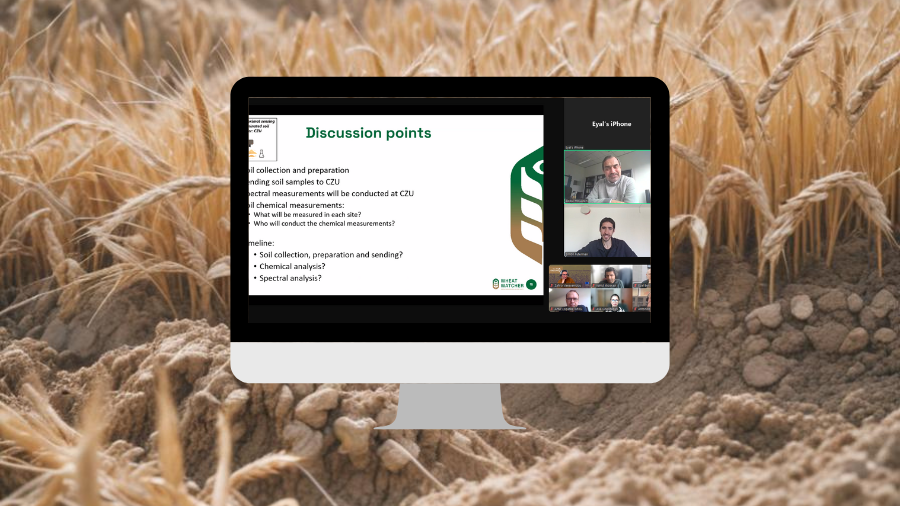
On March 11th, WHEATWATCHER partners gathered online to coordinate the activities of Task 3.2: Proximal Sensing of Contaminated Soil, led by CZU (Czech University of Life Sciences Prague) with key input from Tel Aviv University (TAU). The focus of the meeting was to fine-tune the strategy for developing a soil spectral library—a crucial tool in identifying and modeling the presence of contaminants like petroleum hydrocarbons (TPH), cadmium (Cd), salinity, and sodium chloride using proximal sensing techniques.
The group discussed the preparation of soil samples—both real and artificially contaminated—spanning various textures and geographic conditions. A novel approach was proposed: the creation of synthetic soils by mixing contaminated and non-contaminated samples from nearby fields, enabling a wider range of controlled contamination levels. This will allow the construction of a comprehensive spectral database with at least 100 samples, integrating vis-NIR, MIR, and XRF reflectance data to build predictive models for soil contamination.
Task 3.2 is central to bridging lab work and field deployment. By aligning the spectral signatures from lab-measured samples with satellite data, the project sets the stage for region-scale contaminant detection. The outputs will directly support related activities in WP3 and WP6, including glasshouse experiments and pilot site testing in Greece, Germany, Belgium, and Poland.
With strong collaboration between CZU, TAU, UGent, FHNW, GFZ, and CRA-W, this task is not only advancing soil science but also laying the groundwork for scalable environmental monitoring across Europe.