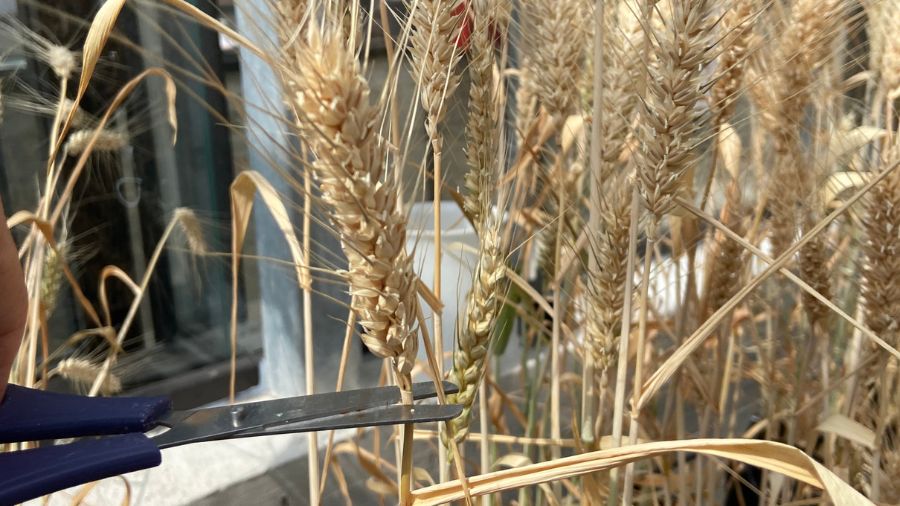
Inside the Glasshouse Experiment
To better understand how contaminants and environmental stressors affect wheat growth and soil health, WHEATWATCHER is conducting a controlled glasshouse experiment at Tel Aviv University (TAU).
This experiment forms part of Task 3.1 and provides a crucial foundation for linking soil conditions, plant responses, sensing technologies, and data-driven monitoring tools.
Unlike field trials, the glasshouse allows researchers to isolate variables, carefully control treatments, and observe cause–effect relationships with high precision.
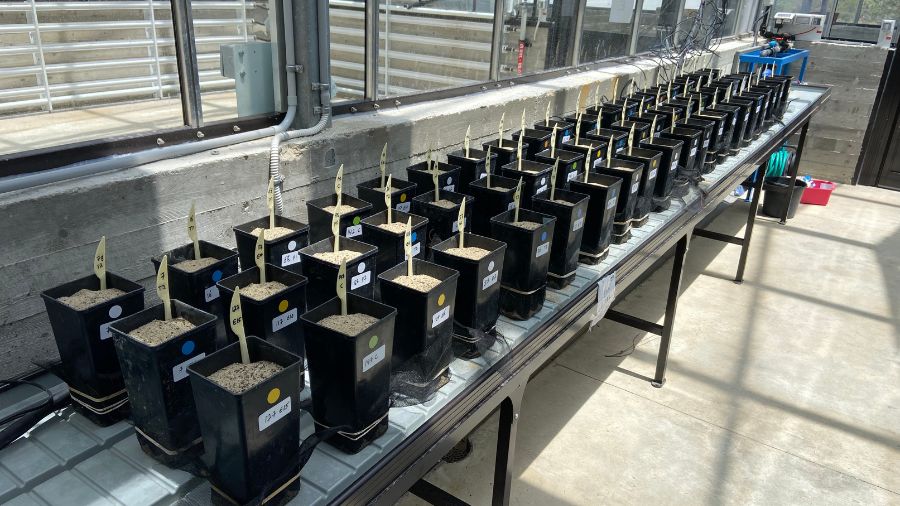
A controlled setup
From February to April 2025, wheat was grown under tightly controlled conditions using:
- 150 pots
- Four treatments:
- Salinity
- Diesel contamination (TPH)
- Microplastics
- Excess nitrogen
- With and without wheat, allowing researchers to distinguish plant-driven effects from soil-only processes
This setup enables direct comparison across treatments and helps identify how each stressor interacts with both soil properties and plant development.
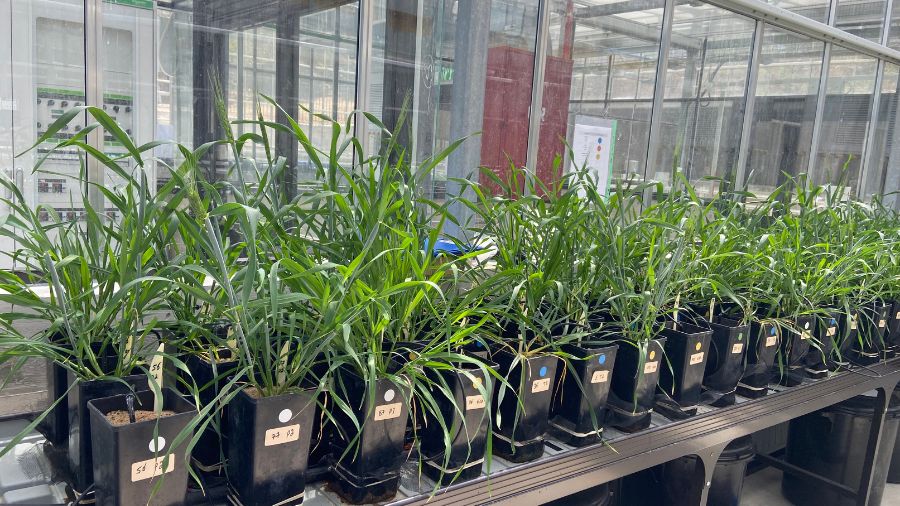
From seedling to grain: tracking wheat growth under stress
Wheat does not simply grow, it responds. Throughout the experiment, plants were monitored from early seedling stages to grain filling and harvest. Each growth phase revealed different stress responses:
- Increased salinity slowed root development and caused leaf yellowing
- Diesel (TPH) exposure affected leaf colour and plant vitality
- Nitrogen boosted height but sometimes disrupted growth balance
- Microplastics altered the soil’s ability to retain water
By observing these responses across stages, the experiment aims to build a visual and analytical “lookup table” linking visible symptoms to specific stressors.
Why this matters: If stress signals can be identified early, farmers and decision-support systems can respond faster and more precisely, reducing yield loss and unnecessary inputs.
What the plant can’t say, the spectrum reveals
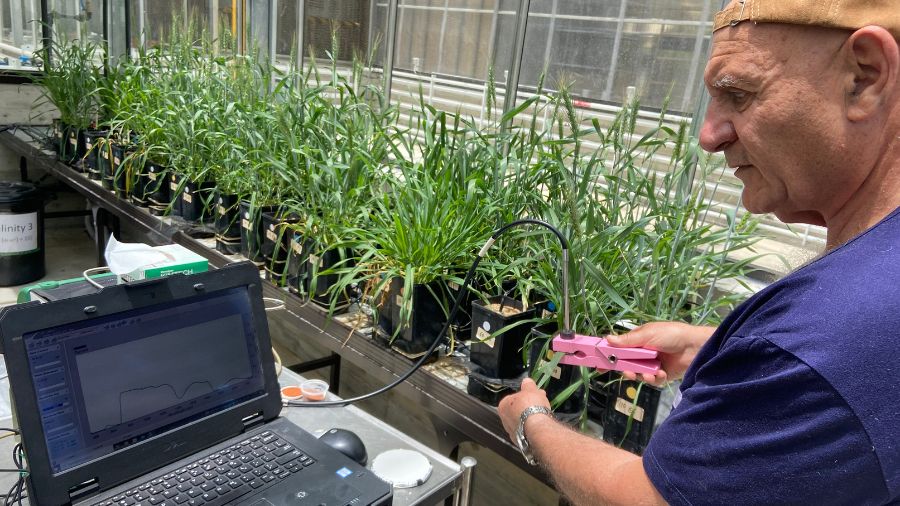
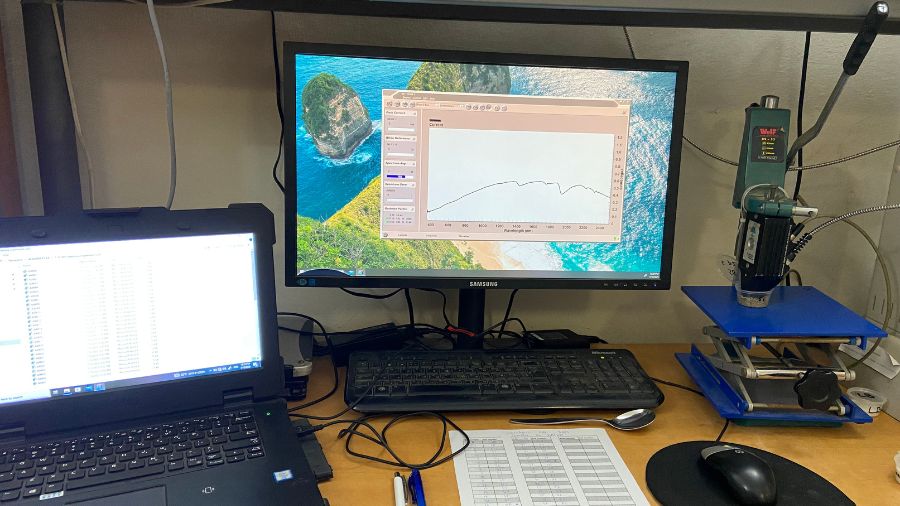
Not all stress is visible to the naked eye. To detect early, subtle changes, the team used VIS–NIR–SWIR hyperspectral sensing (350–2500 nm) to scan wheat leaves.
In the field lab at TAU, Prof. Eyal Ben-Dor and Dr. Simon Futerman, conducted hyperspectral measurements, including scans of plants exposed to diesel contamination (TPH). Each measurement captures how light reflects from the leaf surface: a spectral “fingerprint” that changes under stress.
Why hyperspectral sensing is key:
- Detects early stress before visible damage appears
- Provides insight into nutrient status, water content, and chlorophyll levels
- Feeds high-resolution data into machine learning models for crop-health early warning systems
In short, WHEATWATCHER is not just watching wheat grow, it is listening to what plants reveal through light.
Soil under the spectral lens
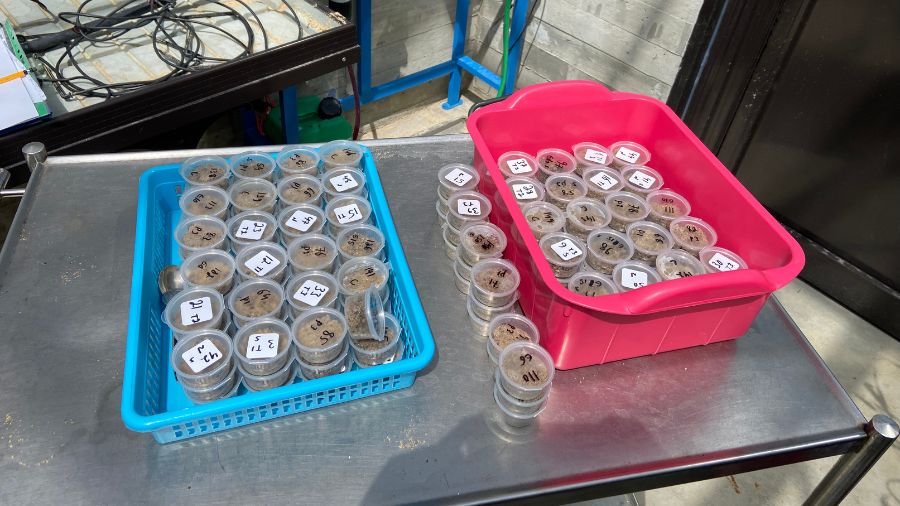
Soil plays an equally critical role in this experiment. After each growing season, soil samples from every pot are:
- Carefully collected
- Air-dried for approximately one week
- Measured in the lab using hyperspectral sensors (350–2500 nm)
These measurements reveal subtle chemical and physical changes caused by each treatment, generating spectral fingerprints of soil under stress.
This is important because:
- Each spectrum tells a story, from contamination to salinity stress
- The data will support spectral soil libraries
- Results feed directly into machine learning models for future soil diagnostics
By looking closely at how soil reflects light, WHEATWATCHER is paving the way for fast, non-invasive, and accurate soil monitoring tools.
The soil microbiome
As part of the experiment, soil samples were collected into tubes containing a stabilizing solution to preserve microbial DNA. These samples are now stored for advanced analysis by the Weizmann Institute of Science. Researchers, including Dr. Dagan Sade and Liza Yakubovich, carefully sampled soil from the experimental pots to study how microbial communities respond to different stressors.
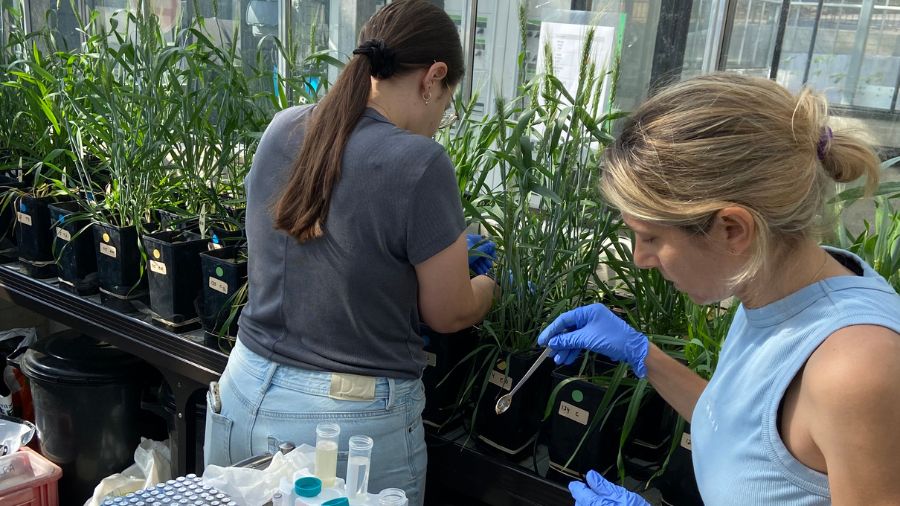
The microbial analysis is crucial as:
- Soil microbial communities shift under contamination and stress
- These changes affect soil resilience, plant growth, and food safety
- Understanding microbial responses helps build predictive models of soil degradation and recovery
Understanding what lives in the soil is just as important as measuring what grows out of it.
Closing the growth cycle
The final stage of the glasshouse experiment was harvest. After weeks of monitoring under the four treatments, wheat plants:
- Dried naturally
- Were harvested pot by pot
- Spikes were stored individually and dried at 60°C
- Grains were separated from chaff and weighed
This process provides high-quality yield data linked directly to each treatment.
Data from the harvest will support:
- Grain quality analysis
- Contamination assessment
- Cross-treatment comparisons
- Integration with sensing and modelling workflows
The importance of the glasshouse experiment for WHEATWATCHER
The glasshouse experiment at Tel Aviv University is a cornerstone of WHEATWATCHER’s approach:
- It links soil, plant, sensing, microbiology, and data science
- It provides controlled reference data for field monitoring
- It supports the development of early-warning systems for soil and crop health
- It strengthens the scientific basis for sustainable, data-driven wheat production
By combining controlled experiments with advanced sensing and modelling, WHEATWATCHER moves one step closer to smarter diagnostics, earlier detection, and better decisions.